
[Note on Brand Evolution] This post discusses concepts and methodologies initially developed under the scientific rigor of Shaolin Data Science. All services and executive engagements are now delivered exclusively by Shaolin Data Services, ensuring strategic clarity and commercial application.
The saying “necessity is the mother of invention” suggests that all valuable innovations must solve an existing problem. However, many of history’s most successful creations arose from a completely different principle: serendipity. Consider the Post-it Note, a wildly successful product created by 3M. It was born not out of necessity, but from a fortunate mistake. A scientist developed a low-tack adhesive that was too weak for its intended use, but another colleague found a new, unintended purpose for it, creating a multi-billion dollar product.
This same principle of accidental innovation is central to the story of Slack, a company that revolutionized how teams communicate at work. To understand its serendipitous rise, you have to go back to its beginnings.
A New Game, a Better Way to Communicate
Before Slack, its founder, Stewart Butterfield, had already built a reputation in the tech world. He co-founded Flickr, an image-sharing service that, like Slack, was also a pivot from an initial video game project. In 2005, Yahoo acquired Flickr. Four years later, Butterfield reunited a team of his former colleagues to form a new company, Tiny Speck. Their goal was ambitious: to develop a massively multiplayer online role-playing game (MMORPG) called Glitch.
Glitch was designed as a non-combative, whimsical game, but while developing it, the Tiny Speck team faced a familiar problem: how to communicate and collaborate efficiently. They built an internal tool for real-time communication that allowed them to organize conversations, share files, and search through their entire history of communication. This tool was a simple, elegant solution to their internal need.
The Accidental Pivot
Despite earning a cult following, Glitch was not commercially viable. The game was shut down, but the team at Tiny Speck realized they had something far more valuable. Their internal communication tool, which they later named “Slack” as an acronym for “Searchable Log of All Conversation and Knowledge,” had potential far beyond their initial use case.
They began sharing the tool with a small group of external users, and the feedback was immediate and overwhelmingly positive. Its growth was an anomaly: what was meant to be a slow rollout became an explosive expansion, growing from 8,000 to 15,000 users in just two weeks. This viral growth, largely attributed to word-of-mouth and recommendations on social media, showed that they had stumbled upon a genuine market need. Slack was not designed to be a Software-as-a-Service (SaaS) product; it was a fortunate accident.
From Startup to Industry Leader
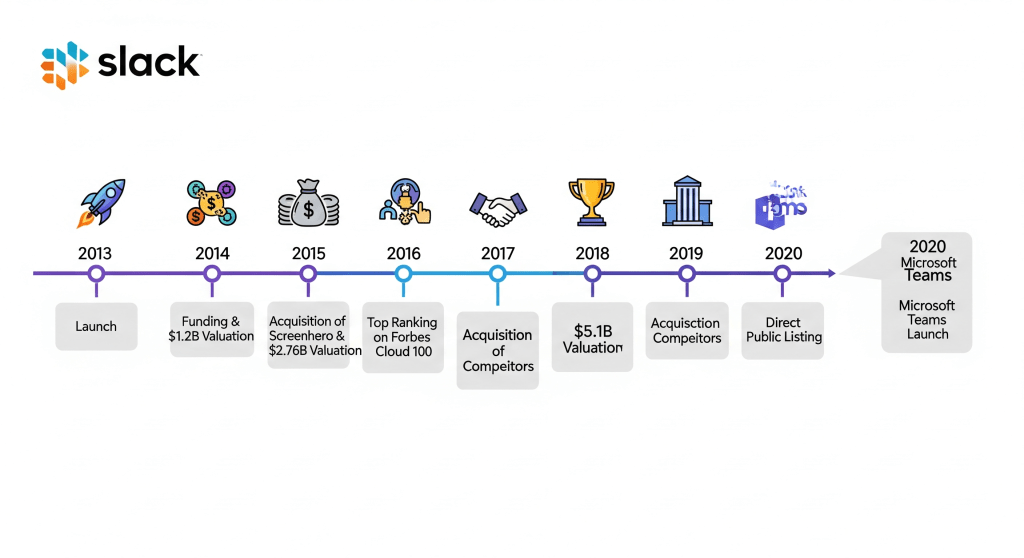
The company’s story from that point on is a testament to its explosive growth.
- 2013: After closing Glitch, the company rebrands to Slack Technologies and launches the public version of its collaboration tool, raising $17 million in startup capital.
- 2014: A period of rapid growth and funding begins. The company raises $162.75 million in venture capital, and its valuation soars to $1.2 billion.
- 2015: Slack acquires Screenhero, a screen-sharing specialist, raises another $160 million in funding, and its valuation nearly triples to $2.76 billion.
- 2016: With a $200 million funding round, the company is named the top-ranked company on the Forbes Cloud 100 list.
- 2017: A $250 million funding round pushes its valuation past the $5 billion mark.
- 2018: Two of its major competitors, HipChat and Stride, announce their closure, with their intellectual properties and user bases being acquired by Slack. This solidifies its market position.
- 2019: Slack opts for a Direct Public Listing on the NYSE rather than a traditional IPO, a move that values the company at an initial price of $26 per share.
- 2020: Microsoft launches Teams, its direct competitor, as a bundled service with its Office suite. This marked the end of Slack’s unchecked market dominance and began a new era of intense competition.
The journey of Slack, from a quirky video game project to a multi-billion dollar enterprise, is a powerful illustration of how innovation often follows an unpredictable path. It demonstrates that while solving a problem is important, sometimes the most revolutionary ideas are the ones you never intended to create.
References:
Clark, K. (2019, May 30). The Slack origin story. TechCrunch. https://techcrunch.com/2019/05/30/the-slack-origin-story/
Shaji, M. (2020, November 17). Story of Slack. TechStory. https://techstory.in/story-of-slack/
 Shaolin Data Services
Leave a comment