
[Note on Brand Evolution] This post discusses concepts and methodologies initially developed under the scientific rigor of Shaolin Data Science. All services and executive engagements are now delivered exclusively by Shaolin Data Services, ensuring strategic clarity and commercial application.
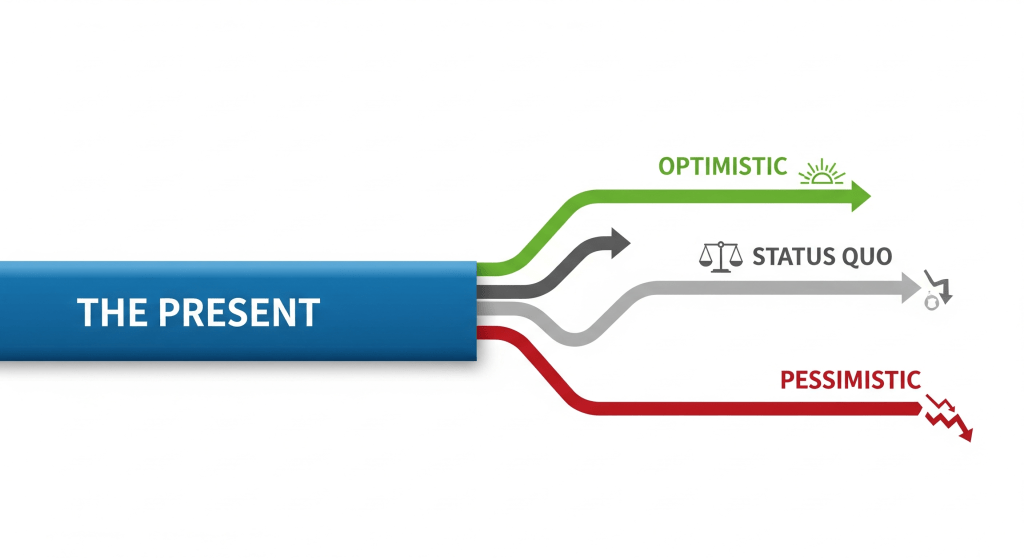
Scenario planning is a practical method for handling highly complex and uncertain forecasts. It proposes a balance between discipline and open-mindedness while offering a compromise between formal models and informal conjecture (Koehler & Harvey, 2004, pp. 274–296). The process begins by categorizing known and unknown information and culminates in blending these two categories into a finite set of internally consistent and valid views or forecasts that describe a range of possibilities.
Scenario Planning in Business
In a business context, the scenario planning mechanism is much the same as in other fields. For example, consider minimizing the uncertainty surrounding innovation and new product development. Most successful businesses are acutely aware of the complexities that drive profits and positive returns on investments. While probabilistic models are often used to analyze complex problems through algebraic formalization, they are most appropriate for analyzing uncertainty synonymous with risk (Derbyshire & Giovannetti, 2017). Therefore, scenario planning is the more appropriate tool for handling edge cases within extreme, uncertain conditions.
Typical forecasting methods emphasize the continuity of an established trend. By contrast, the “extreme worlds” of scenario planning emphasize the discrete, or the discontinuity of unexpected outcomes or outliers (Derbyshire & Giovannetti, 2017). The crucial observation here is that scenario planning and stochastic modeling are both tools for handling forecasts with high uncertainty and complexity. Thus, while a complete set of scenarios may make up a forecast, a single scenario represents an individual possible outcome under a specific set of circumstances. Each defined scenario depends on a given path for its occurrence.
In the context of new product development, possible paths include consumer resistance, where people choose the familiar over the new, and consumer lock-in due to the positive feedback loop of prior products (Derbyshire & Giovannetti, 2017). Businesses must account for such discontinuity, regardless of existing market trends or the applicability of predicted use cases. This means including scenarios for rival product trends, competitor market-share growth rates, and network effects, as well as for inducing positive feedback and market disruption. For instance, consider the transformative impact of the internet on society since its advent.
Scenario Planning in Plain Sight
Science fiction has always played a significant role in technological advancement, epitomizing the saying attributed to Abraham Lincoln: “The only way to predict the future is to create it.” The Hitchhiker’s Guide to the Galaxy, by Douglas Adams, contains many fantastic predictions. In 1979, before the internet as we know it existed, Adams wrote about the Sub-Etha, a fictional wireless telecommunications network that the Guide used to ubiquitously transfer data (BBC Radio 4 – The Hitchhiker’s Guide to the Galaxy – How Douglas Adams Changed the Future, 2023). While the internet’s predecessor, ARPANET, existed at the time, the modern concept of the World Wide Web did not emerge until 1989. Adams’s work explored a future where wireless data transfer was commonplace.
Along with a clinically depressed robot, Adams also envisioned the Guide as an electronic encyclopedia resembling what is today called Wikipedia and looking much like a modern tablet computer with voice activation (BBC Radio 4 – The Hitchhiker’s Guide to the Galaxy – How Douglas Adams Changed the Future, 2023). Science fiction often takes the most interesting scenarios and attempts to predict a future where such things exist. This type of scenario planning aims to explore a given world within that scenario and make the best of the offering. It proves that scenario planning is intuitive; plausibility and imagination are the only requirements.
References:
A short history of the Web. (2023, June 28). CERN. https://home.cern/science/computing/birth-web/short-history-web
BBC Radio 4—The Hitchhiker’s Guide to the Galaxy—How Douglas Adams changed the future. (2023). BBC. https://www.bbc.co.uk/programmes/articles/2qnK6Z7xpJdvMxG10Q99s38/how-douglas-adams-changed-the-future
Derbyshire, J., & Giovannetti, E. (2017). Understanding the failure to understand New Product Development failures: Mitigating the uncertainty associated with innovating new products by combining scenario planning and forecasting. Technological Forecasting and Social Change, 125, 334–344. https://doi.org/10.1016/j.techfore.2017.02.007
Koehler, D. J., & Harvey, N. (Eds.). (2004). Blackwell handbook of judgment and decision making (1st ed). Blackwell Pub.
 Shaolin Data Services
Leave a comment