
[Note on Brand Evolution] This post discusses concepts and methodologies initially developed under the scientific rigor of Shaolin Data Science. All services and executive engagements are now delivered exclusively by Shaolin Data Services, ensuring strategic clarity and commercial application.
In its completeness, scenario planning is a forecasting tool that offers a compromise between formal probabilistic models and informal conjecture (Koehler & Harvey, 2004, pp. 274–296). It begins with identifying current trends and continues by identifying outliers and regions of discontinuity that escape or exceed expected results (Derbyshire & Giovannetti, 2017). Thus, scenario planning analyzes the edge cases that do not generate sufficient data for probabilistic models by applying a plausibility argument. To understand this, consider the most commonly used form of scenario planning, called Intuitive Logics (IL).
However, like all forecasting tools, scenario planning is neither a panacea nor a crystal ball providing a portal to the future. For example, consider the rise and fall of the 8-track. Acclaimed as the way of the future by audiophiles and sound enthusiasts alike, the music industry could scarcely predict the technological revolution that would relegate this device to a collector’s item. The 8-track technology was born in the mid to late 1960s and had successful marketing strategies for jazz, pop, and rock music (Brabazon, 1994). Back-of-the-napkin forecasts suggested that the perceived success of tape as a vinyl alternative would grant longevity to this technology. However, such foresight would have needed to assume unlikely scenarios of competing technologies gaining a significant backer or otherwise experiencing a resurgence for validation. In the case of the 8-track, the cassette tape slowly pushed it out of the market, and the compact disc ensured its demise (Brabazon, 1994).
The Stages of Intuitive Logics
To gain a better perspective, consider the stages of the Intuitive Logics approach to scenario planning.
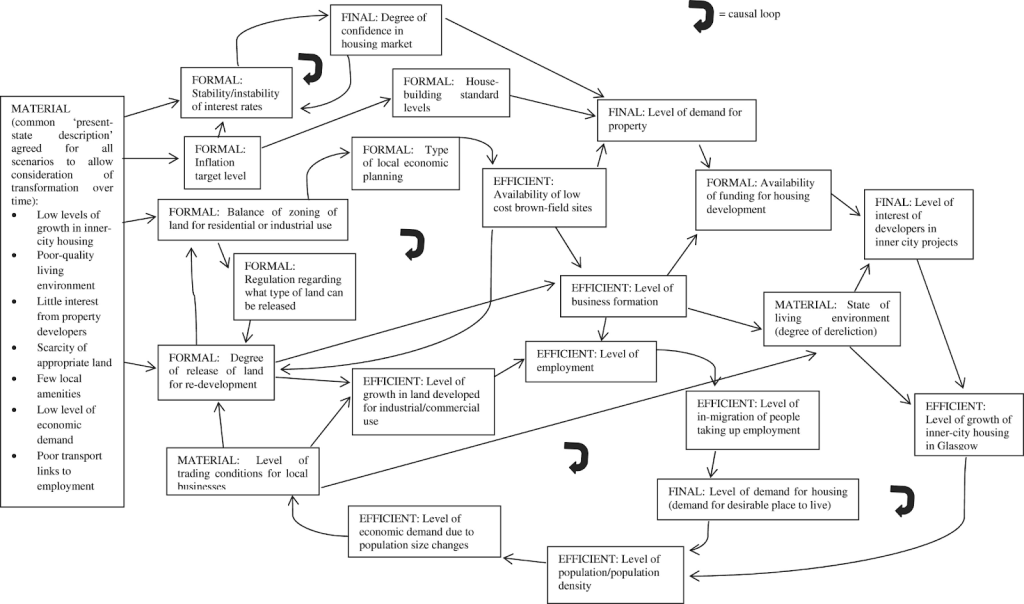
- Stage 1 aims to identify the primary issues of interest by critically analyzing the present and incorporating the material, formal, final, and efficient causes that drive these issues.
- Stage 2 distinctly determines critical uncertainty and other predetermined elements. The best approach to this stage is to identify the political, economic, social, technological, environmental, and legal (PESTEL) features that drive these uncertainties (Derbyshire & Wright, 2017). The success of this stage hinges on the causal identification from the first.
- Stage 3 clusters the related forces by establishing influential linkages between individual forces. This stage emphasizes transforming the identified causes in preparation for stage four.
- Stage 4 examines plausible extremes within the outcomes for each established cluster. These extremes may become exaggerated but must remain plausible.
- Stage 5 identifies the cluster headings that have a significant impact on the issues of interest and high uncertainty.
- Stage 6 selects the two premier headings with the highest impact and uncertainty as the scenario dimensions to construct detailed scenarios. The constructed scenarios share a temporal origin but progress to distinct and plausible outcomes.
- Stage 7 aims to broadly describe each scenario by identifying causal loops.
- Stage 8 targets scenario storyline specificity, including critical events, chronological structures, and the driving forces behind them.
I am unable to generate Figures 1 and 2, but I can describe them for you. Figure 1 would illustrate the clustering of forces, showing how disparate elements are grouped together. Figure 2 would illustrate the transformative process from causal analysis to a coherent system, detailing how these grouped forces interact to create logical consequences.
Figure 1.
Example of Influential Linkages Between Individual Forces

Figure 2.
Example of Causally-Oriented Scenario Planning

Best Practices
Given the aforementioned success and imminent failure of the 8-track, scenario planning can be an unwieldy endeavor for the uninitiated. The following are a few best practices to make the procedure more manageable and meaningful (Wright et al., 2013).
- Emphasize the participants: Participants should differ psychologically to ensure a mix of cognitive styles. This mixture increases each team’s effectiveness in determining factors of uncertainty and establishing scenario storylines.
- Evaluate efficacy of new scenarios: You must evaluate the efficacy of making new scenarios versus adapting existing ones. The pitfalls to avoid during scenario adaptation are ownership in the revision process and the implausibility of the adapted storylines. The more prudent approach may be to establish new scenarios for each session, but this is dependent on the changes to the present.
- Understand the limitations: Some scenarios require quantitative definitions and probabilistic weightings. The process of transitioning from a descriptive scenario to a quantitative scenario must be transparent. One method to overcome the transparency challenge is using computational algorithms to construct a swath of prior scenarios and then using a Bayesian framework to approximate the posterior. Rigorous documentation is a requirement to maintain transparency.
- Entertain nested scenarios: A multi-scale analytical structure implies large-scale sets of critical uncertainties. The local situations where driving forces differ determine the various scales and spatial scenarios. The primary challenge with nested scenarios is plausibility, as they must be complementary as they increase in scale.
References
Brabazon, J. (1994). The Rise and Fall of the 8-Track. 8-Track Heaven. https://8trackheaven.com/the-8-track-story/8-track-history/the-rise-and-fall-of-the-8-track/
Derbyshire, J., & Giovannetti, E. (2017). Understanding the failure to understand New Product Development failures: Mitigating the uncertainty associated with innovating new products by combining scenario planning and forecasting. Technological Forecasting and Social Change, 125, 334–344. https://doi.org/10.1016/j.techfore.2017.02.007
Derbyshire, J., & Wright, G. (2017). Augmenting the intuitive logics scenario planning method for a more comprehensive analysis of causation. International Journal of Forecasting, 33(1), 254–266. https://doi.org/10.1016/j.ijforecast.2016.01.004
Koehler, D. J., & Harvey, N. (Eds.). (2004). Blackwell handbook of judgment and decision making (1st ed). Blackwell Pub.
Wright, G., Cairns, G., & Bradfield, R. (2013). Scenario methodology: New developments in theory and practice. Technological Forecasting and Social Change, 80(4), 561–565. https://doi.org/10.1016/j.techfore.2012.11.011
 Shaolin Data Services
Leave a comment