
[Note on Brand Evolution] This post discusses concepts and methodologies initially developed under the scientific rigor of Shaolin Data Science. All services and executive engagements are now delivered exclusively by Shaolin Data Services, ensuring strategic clarity and commercial application.
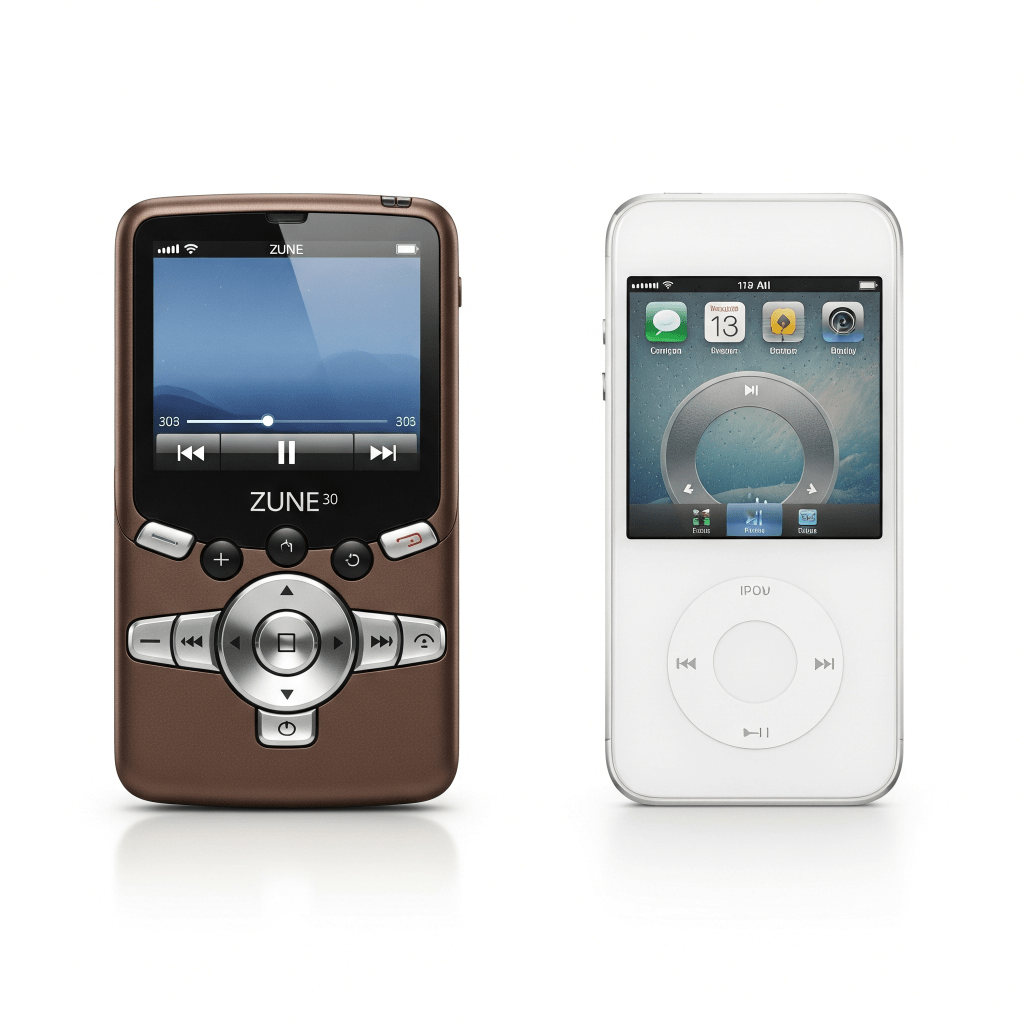
Some companies have track records with their products that appear perfect, but occasionally they launch a product that performs terribly in the market. An example is the Nintendo Virtual Boy, which simply did not perform up to expectations as a virtual reality experience. However, another example is occasionally portrayed as a battle between two companies in the consumer electronics market. Consider the example of the Microsoft Zune and the Apple iPod.
First, briefly consider the comparisons between the two products listed in Table 1 (Diffen, n.d.).
Table 1.
Zune iPod Comparison Chart.
| Microsoft Zune | Apple iPod | |
| Price | $150 – $250 | $49 – $399 |
| Compatibility | Windows | Macintosh, Windows |
| Audio Format | mp3, mp4, aac, wma | mp3, mp4, aac, wav, m4a, Apple Lossless |
| Image Format | jpeg | jpeg, bmp |
| Video Format | mpeg-4, wmv, h.264, DivX | mpeg-4, m4v, h.264 |
| Battery Life | 14 hours | 12 – 24 hours, depending on the product |
| FM Radio | Yes | No |
| Units Sold (millions) | 1.2 | 20.35 |
| Display | Color OLED | Color LCD with LED backlight or Multi-Touch |
| Wireless | 802.11n | iPod Touch only |
Purely from the product deployments, it is easy to make certain assumptions. Specifically, hindsight suggests that Microsoft had a fantastic advertising campaign to sell 1.2 million units in an already dying market. Then, Zune was a product that pivoted from the prior MSN music endeavor in Microsoft’s attempt to give its users a mobile music device (Montes de Oca, 2020). Microsoft also launched a subscription service for Zune that allowed users to download music freely. However, many elements coalesced to force Microsoft to discontinue their product.
The first of these forces was the timing of their innovation. The mobile music market was nearing the end of its duration at the time of the product launch. This was not something that Microsoft could have had any control over, even if they launched the Zune in a different color. The death of this market silenced any endeavors from additional companies seeking mobile music fame. Although the user base and the strength of their product guaranteed company stability, Apple was also affected to a degree.
Another force outside of Microsoft’s control was the vision of its competitors. Specifically, the competition between companies for mobile music dominance was not necessarily an immediate factor. However, while Microsoft focused on perfecting the Zune and increasing its cult following to a certifiable market share, Apple focused its efforts on developing and deploying the iPhone. Then, if any other company had launched a device with an AI assistant, telephonic functions, mobile music, and other capabilities, the mobile music market would have met its end the same way. So the force that crippled Zune’s efforts was the vision and farsightedness of Apple’s leadership rather than Apple itself.
References:
Diffen. (n.d.). Zune vs iPod—Difference and Comparison | Diffen. Retrieved August 10, 2023, from https://www.diffen.com/difference/Zune_vs_iPod
Montes de Oca, B. (2020, September 1). Zune Vs. Ipod: How Microsoft Challenged Apple (And Lost). https://slidebean.com/story/microsoft-zune-the-microsoft-ipod, https://slidebean.com/story/microsoft-zune-the-microsoft-ipod
 Shaolin Data Services
Leave a comment