
[Note on Brand Evolution] This post discusses concepts and methodologies initially developed under the scientific rigor of Shaolin Data Science. All services and executive engagements are now delivered exclusively by Shaolin Data Services, ensuring strategic clarity and commercial application.
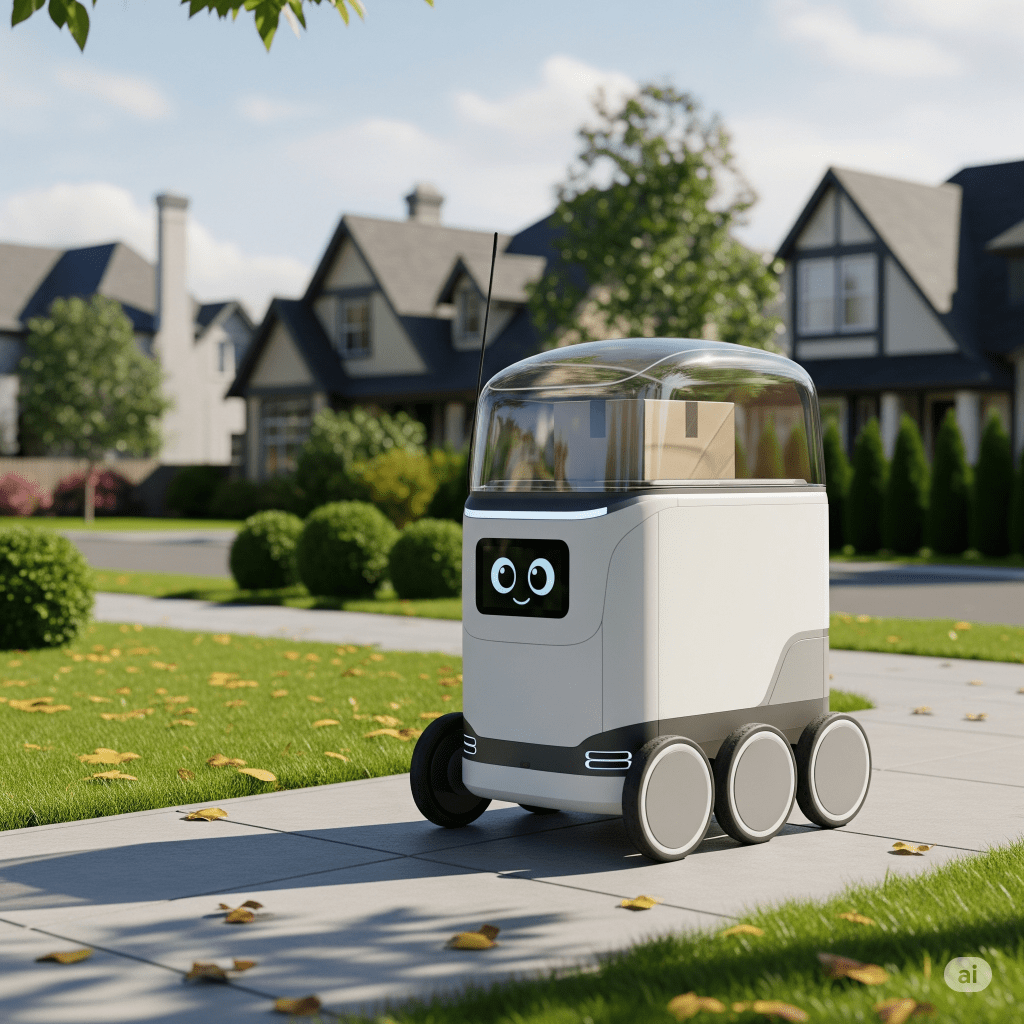
The future of delivery services is not a question of if it will change, but how and when. While we often focus on the technology itself, the success or failure of a new system rests on more than just its technical merit. It relies on the subtle, yet powerful, interplay between technology and the people who use it. This is the essence of a socio-technical system, a framework that broadens our definition of a successful product to include the user’s experience and the surrounding social environment.
This article outlines a socio-technical deployment plan for autonomous robot sidewalk delivery, analyzing its innovation scope, purpose, and the forces that will shape its adoption. By looking beyond the robot itself, we can identify the true path to a successful and sustainable launch.
A User-Centered System
Widespread and well-known products do not mandate user mastery. Instead, they leverage the Dunning-Kreuger effect, where the user only needs to believe they have mastered the tool sufficiently for their needs. The critical aspect of a system that keeps users engaged is that they enjoy using it. Most people will not jump through hoops to achieve their goals. The extended definition of a system, therefore, means accounting for non-technical users and the necessary supporting infrastructure for widespread deployment.
Innovation Scope
Consider the innovation that robots and drones bring to delivery services. Three key features of this type of innovation are the cleanliness or sanitation of the delivered product, the volume of delivered products, and the consistency of deliverables. In a world where COVID has yet to be truly vanquished, many find masks uncomfortable or too inhibiting. Moreover, expecting delivery drivers to religiously sanitize themselves and their vehicles before, during, and after every delivery is unreasonable. Thus, the risk of delivering unrequested payloads is not negligible, given that the risk of compromise is shared between delivery drivers, pickup, and destination. Then, immunodeficient consumers are inadvertently left behind and face more significant risks for mundane errands. Having the drone or robot return to a central base station with automated sanitary procedures minimizes this risk by reducing the biological influence.
Services like Uber Eats greatly benefit from robotic fleets by increasing the available units to make deliveries. Specifically, after a reverse acquisition, Serve entered a commercial agreement to provide 2000 robots to Uber Eats delivery services (Korosec, 2023). This benefits the producer by delivering more products and increasing their revenue through an increased number of customers served per hour. This benefits the consumer by reducing the time necessary to wait for a unit to become available to deliver their order. With sufficient delivery units for a given service, the time between requesting and receiving a product becomes more consistent. More people can request service without fear of feeling like second-class citizens. This also reduces the stress placed on existing delivery drivers when enforcing company promises such as “30 minutes or less.” With sufficient delivery units, more customers would be satisfied that the cold tuna sub they requested is still cold upon receipt in the middle of a 100-degree Florida summer.
The immediately foreseeable limitation to this innovation is having sufficient delivery units. While the increased audience bodes well for local business longevity, a larger audience means at least one unit per household. Given the average suburb’s population, expecting a designated fleet per subdivision may be unreasonable. This excludes backup units to supplement the expectable wear-and-tear of transit or typical immature vandalism. This also does not include units that must traverse uncommon terrain for more undeveloped regions.
Innovation Purpose
The primary purpose of autonomous sidewalk robot delivery systems is to capitalize on the market sector started by companies such as Postmates. Specifically, Serve Robotics spun out of Uber’s acquisition of Postmates (Korosec, 2023) and is in an excellent position to expand delivery services in the more virus-conscious parts of society. Thus, this type of innovation lowers the entry barrier for local businesses, such as restaurants or delis, to ship their goods to their local community. This innovation also decreases the burden of sidewalk delivery by minimizing human exposure to extreme temperature conditions during peak delivery hours.
Supporting Forces
Local businesses stand to gain the most from autonomous sidewalk robot delivery systems. Specifically, delis, restaurants, cafes, and other such businesses can more easily reach their neighbors with their goods. Having a robot deliver the goods also means minimizing the risk of exposure to COVID-19 or other such viruses. Minimal biological exposure means immunocompromised individuals can be included in delivery prospects. Including immunocompromised individuals suggests a more extensive customer base and increased avenues for business expansion.
Challenging Forces
However, the traversable terrain is the primary drawback to autonomous sidewalk robot delivery. For example, sidewalks in disrepair or with missing sections, continuous construction, the general incompetence of civil infrastructure, or sidewalks that are indiscernible from the local garbage dump despite the efforts of the city’s custodial personnel are forces that would significantly challenge the dissemination of this innovation to the general public. Specifically, the local community is its own most significant impediment to advancement. Then, if the community condones acts of vandalism, a company may decide that the losses outweigh the gains for such a venture. This phenomenon is already seen with existing delivery services that refuse to deliver goods within particular domains.
Decision-Making Methods
Data should drive decision-making for deploying this system to achieve the optimal value derived from the service. Using big data analytics techniques for large-scale decision-making provides an objective basis to enrich decision-making power (Tang & Liao, 2021). The general framework behind this process is as follows:
- Intelligence phase: Data mining from social media platforms like Reddit and Twitter, then aggregate comments according to commercial or residential zoning.
- Design phase: Analyzing the available courses of action through clustering analytics, regression analysis, classification, and sentiment analysis toward the challenging forces.
- Selection phase: Described by the evaluation and decision-making stages. Visualize the clusters and states of the design phase to determine prospective launch locations.
- Implementation phase: Use the derived solution from the previous stages to propose prospective businesses and services for whom to provide autonomous robot sidewalk delivery services, categorized by geographic location and ranked according to projected initial losses in ascending order.
Forecasting Models
In its completeness, scenario planning is a forecasting tool that compromises formal probabilistic models and informal conjecture (Koehler & Harvey, 2004, pp. 274–296). Thus, the first step is to identify current trends and continue by identifying outliers and regions of discontinuity that escape or exceed expected results (Derbyshire & Giovannetti, 2017). Then, consider the following application of the Intuitive Logics methodology. Figure 1 illustrates the straightforward and clustered approach, whereas Figure 2 illustrates an approach with causal orientation. Notably, Singapore established a program for robot delivery services to enhance livability and the quality of life and increase the sustainability of its infrastructure (Tham, 2021). Thus, Figure 1’s clustering of influential forces and Figure 2’s successful paths use Singapore’s activities as reference material.
Figure 1.
Clusters of Interconnected Linkages

Figure 2.
Causally Oriented Intuitive Logics Scenario.

Analytical Plan
The buy-in from business and delivery hubs details this plan’s overarching success or failure rate. On a more granular level, individual metrics such as successful deliveries per hour, the investments of local businesses to provide deliverable products and services to local consumers, and a community’s adaptability determine the longevity of autonomous sidewalk robot delivery within a given locale. Specifically, countries such as Singapore and Japan successfully deploy robots for various tasks because of a social and cultural understanding that menial labor is not something an individual should aspire to.
Anticipated Results
The results will vary by country and geographic location. For example, Singapore enabled delivery services for perishables such as milk and eggs (Reuters, 2021). Conversely, Singapore is a city-state and can enact policies or have local government backing for various initiatives with little pushback. Similarly, the Japanese answer to COVID was also robotic for its testing, diagnosis, and quarantine. However, that is another case where the country’s culture lauds advancement and prefers to observe the past while learning its lessons without holding on tightly in fear of an unknown future.
Conclusion
The success or failure of an autonomous robotic sidewalk delivery will result from the progressiveness or regressiveness of the society into which it is ultimately deployed. Therefore, the diffusion of this type of innovation must begin from a community that understands the efficacy of time management. Specifically, places like Silicon Valley, Austin, Raleigh-Durham, or other regions with a more progressive stance toward technological development are fertile grounds to plant the seeds of robotic services. Conversely, places with a more progressive stance toward technological impact and usage, such as New York, are also worthwhile locations to launch a robotic endeavor.
The primary factor to consider when determining the launch of robotic innovation is its longevity. Specifically for the impact on the community into which it is unleashed and the community’s acceptance and interpretation of innovative ideas. Then, suppose preliminary analysis suggests that the community will respond by observing only what opportunities were lost in the technological revolution. In that case, avoiding that community may be more prudent until different circumstances allow the company to accept large losses for an initial deployment. Conversely, if the community has a track record of responding enthusiastically to change and new ideas, that may be a different story.
The deployment and innovative diffusion should be straightforward for the community that greets innovation enthusiastically, such as Raleigh-Durham, Austin, or other similarly-minded communities. Specifically, the critical factor for deploying autonomous robot delivery primarily relies on the vendors in a given area. In that case, the local businesses would need a distribution hub to support the delivery services or rent a small fleet for their use case. The distribution hub would function in the same manner as a personal shopper. The consumer places the request, and their completed order gets delivered by a robot to their desired location. In this manner, human interaction with the consumer’s goods happens in a sterile environment. From the consumer perspective, it is marginally different from the grocery store “pick-up” experience some places offer. The benefit of ordering using the robot delivery service is that the consumer’s goods must only be minimally exposed upon retrieval.
Then, renting the robot for delivery use cases becomes primarily available for local delis and restaurants. Most local businesses use services such as Door-Dash and Uber Eats. The primary distinction for autonomous robotic sidewalk delivery is granting an otherwise ordinary restaurant a designated robotic delivery driver. If the restaurant already has a delivery driver, the robotic delivery option can be temporary for high-velocity customer orders or the driver is otherwise indisposed. However, the primary emphasis of such an argument is offering a dedicated service to local businesses at an affordable rate. On the one hand, the business can expand its options and reach more customers by being provided with new capabilities. On the other hand, the cost a business faces for having delivery services can decrease by using robotic units instead. This allows that business to generate more revenue by increasing the amount of staff on its serving and receiving lines.
The overall impact of autonomous sidewalk robotic delivery services depends on a given vantage point. Then, this innovation does not aim to remove jobs from existing holders, though it may happen. Instead, such innovation aims to grant humans more free time to do as they please and aspire to something greater than a delivery driver. Therefore, this innovation would not immediately phase out or eliminate existing delivery personnel. Instead, it expands the capabilities of local businesses by giving them delivery capabilities if they had none before. Then, it allows the next generation to aim higher, take advantage of technology, and further the work of their predecessors.
Areas of Future Research
Critical areas for future research are using the data the robots acquire to expand the influence of local businesses and the capabilities of autonomous robots. For example, a restaurant may use its delivery robots to gather survey data for customer experience or tastes. Additionally, they may provide recipe suggestions based on prior ordering trends in the vein of predictive analytics for potential meals and ingredients. Autonomous robots also would greatly help emergency response teams. Specifically, the fire department and emergency medical technicians would greatly benefit from the extra pair of hands.
References
Derbyshire, J., & Giovannetti, E. (2017). Understanding the failure to understand New Product Development failures: Mitigating the uncertainty associated with innovating new products by combining scenario planning and forecasting. Technological Forecasting and Social Change, 125, 334–344. https://doi.org/10.1016/j.techfore.2017.02.007
Derbyshire, J., & Wright, G. (2017). Augmenting the intuitive logics scenario planning method for a more comprehensive analysis of causation. International Journal of Forecasting, 33(1), 254–266. https://doi.org/10.1016/j.ijforecast.2016.01.004
Hayashi, E. C. S., & Baranauskas, M. C. C. (2013). Affectibility in Educational Technologies: A Socio-Technical Perspective for Design. Journal of Educational Technology & Society, 16(1), 57–68.
Koehler, D. J., & Harvey, N. (Eds.). (2004). Blackwell handbook of judgment and decision making (1st ed). Blackwell Pub.
Korosec, K. (2023, August 10). Uber, Nvidia-backed delivery robot startup Serve Robotics to go public. TechCrunch. https://techcrunch.com/2023/08/10/uber-nvidia-backed-delivery-robot-startup-serve-robotics-to-go-public/
Reuters. (2021, April 12). Robots on call for Singapore home deliveries. https://nypost.com/2021/04/12/robots-on-call-for-singapore-home-deliveries/
Sharma, L. (2022, August 4). 10 nonfunctional requirements to consider in your enterprise architecture. Enable Architect; Red Hat, Inc. https://www.redhat.com/architect/nonfunctional-requirements-architecture
Tang, M., & Liao, H. (2021). From conventional group decision making to large-scale group decision making: What are the challenges and how to meet them in big data era? A state-of-the-art survey. Omega, 100, 102141. https://doi.org/10.1016/j.omega.2019.102141
Tham, D. (2021, March 11). Robots to deliver groceries and parcels to Punggol HDB residents as part of a trial. CNA. https://www.channelnewsasia.com/singapore/autonomous-robot-delivery-punggol-imda-otsaw-camello-321246
 Shaolin Data Services
Leave a comment