
[Note on Brand Evolution] This post discusses concepts and methodologies initially developed under the scientific rigor of Shaolin Data Science. All services and executive engagements are now delivered exclusively by Shaolin Data Services, ensuring strategic clarity and commercial application.
The quest for artificial general intelligence often leads us to focus on the human brain. We pursue a goal of replicating its 86 billion neurons, a challenge that, even on a conceptual level, consumes vast amounts of power and resources. But what if the blueprint for a new era of AI isn’t in our own minds, but in the highly specialized and profoundly efficient brains of insects?
This is the strategic paradox we must understand. While a human brain has over 86 billion neurons, a dragonfly’s brain has a mere 1 million. Yet, that seemingly simple biological computer is a masterpiece of specialized intelligence, capable of achieving remarkable feats with a fraction of the power. This is the new frontier for artificial intelligence, and it holds the secret to creating systems that are not just powerful, but also efficient, precise, and autonomous.
In a recent TED Talk, computational neuroscientist Frances S. Chance presented a powerful argument for this approach. She posits that while insect brains are significantly smaller than human brains, successfully replicating even a single insect brain remains a challenge. The crucial observation of this argument is that insects are specialists at the singular tasks for which they are known. In the case of a dragonfly, it is a hunting specialist with a staggering 95% success rate.
When a dragonfly hunts, it needs to intercept a moving target. To do this, it must perform a complex coordinate transformation between what its eyes see and what its body needs to do. While our computers would perform this in a sequence of calculations, the dragonfly does it in approximately 50 milliseconds, a timeframe that spans just four layers of neurons. It’s a single, lightning-fast computational step that redefines what we thought was possible.
This incredible efficiency lays the foundation for understanding neuronal interconnections. By applying predictive analytics to determine the neurons responsible for these kinds of precise, single-step transformations, researchers are paving the way for a new generation of AI. These systems would not only mimic insectoid behavior but would also minimize the power consumption of computing devices, a critical factor for the widespread deployment of autonomous robotics.
The Power of Specialization
To understand this advantage, we must look at the dragonfly, a hunting specialist with a staggering 95% success rate. How does a brain of just 1 million neurons achieve such impeccable results? The answer lies in its ability to perform highly complex calculations in a single, elegant step.
When a dragonfly hunts, it needs to intercept a moving target. To do this, it must perform a complex coordinate transformation between what its eyes see and what its body needs to do. While our computers would perform this in a sequence of calculations, the dragonfly does it in approximately 50 milliseconds, a timeframe that spans just four layers of neurons. It’s a single, lightning-fast computational step that redefines what we thought was possible.
This incredible efficiency lays the foundation for understanding neuronal interconnections. By applying predictive analytics to determine the neurons responsible for these kinds of precise, single-step transformations, researchers are paving the way for a new generation of AI. These systems would not only mimic insectoid behavior but would also minimize the power consumption of computing devices, a critical factor for the widespread deployment of autonomous robotics.
Unleashing Autonomous Potential: Lessons from the Insect World
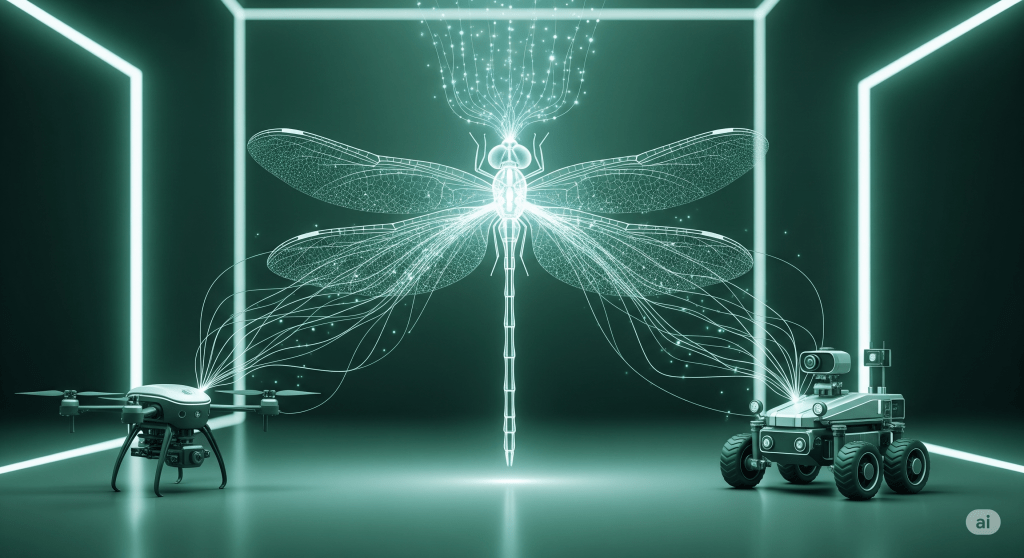
The implications of insect-brain-inspired AI extend far beyond theoretical computing. Imagine a new generation of autonomous robots – drones, rovers, and even legged systems – capable of navigating complex environments with unparalleled efficiency and precision. These robots, drawing inspiration from the insect world, present a revolutionary opportunity for tasks like autonomous crop monitoring across vast agricultural landscapes or reliable, pinpoint delivery services within a one-kilometer radius right here in Jacksonville.
Consider the limitations of current autonomous navigation. Modern mapping relies heavily on Simultaneous Localization and Mapping (SLAM) algorithms. While effective, SLAM demands significant computational resources, often exceeding the capacity of many small, embedded onboard robots (De Croon et al., 2022). This computational cost restricts the size, weight, and deployment scale of these autonomous systems.
However, the insect brain offers a different paradigm. Its efficiency in tasks like the dragonfly’s interception maneuver suggests that complex navigation and decision-making can be achieved with vastly fewer computational resources. By mimicking these biological architectures, we can potentially create autonomous robots that are smaller, lighter, more energy-efficient, and capable of operating in environments where current systems struggle.
This insect-inspired autonomy holds the key to deploying fleets of robots for a multitude of tasks, from monitoring the health of our local ecosystems to providing rapid and reliable delivery services throughout Jacksonville’s diverse neighborhoods. The ability to achieve sophisticated navigation and task completion with minimal computational power is a game-changer, paving the way for a truly autonomous future.
The Paradox of Progress: The Challenge of Replication
While the potential of insect-inspired AI is undeniable, the path to its widespread deployment is not without its obstacles. The primary impediment is a fundamental paradox of design: a system that aims to achieve elegance and simplicity must first overcome a daunting level of complexity.
Specifically, the challenge lies in the intricate interconnections of neurons within an insect’s brain, which far exceed our current computational capabilities to replicate in their entirety. In an attempt to surmount this, researchers have adopted a few key approaches (De Croon et al., 2022):
- Divide-and-Conquer: Solutions are broken down into sub-modules, with each part designed to mimic a specific biological function.
- Biological Analogy: The design relies on drawing direct inspiration from a known biological process for a particular task.
- Machine Learning: Researchers use machine learning to automate the design process, allowing the system to form its own architecture.
However, the crucial observation of these approaches is that each implicitly increases the very complexity they are trying to simplify. This is the paradox: a simple, energy-efficient system can only be achieved by overcoming an incredibly complex design problem. The solution, therefore, requires a strategic mindset that goes beyond simply replicating what we see; it requires an understanding of the underlying principles that make insect brains so powerful.
Conclusion: The New Frontier of Intelligent Design
The pursuit of AI has often been a race to replicate the human brain, a goal that demands immense power and computational resources. But the true future of intelligent systems may not be about scale. It may be about specialization, elegance, and efficiency.
As our analysis of insect-brain AI reveals, the path to a new generation of autonomous systems lies in a strategic shift in our thinking. We must learn from nature’s most efficient specialists, like the dragonfly, which achieves incredible feats of navigation and precision with a mere fraction of the resources we currently require. This inspiration opens the door to creating a new breed of AI that is not only powerful but also energy-efficient and scalable for deployment in the real world.
The challenge is not one of technology, but one of design. The paradox of replicating a simple, elegant system is a problem that demands a new approach. It requires a strategic vision that looks beyond brute-force solutions and instead seeks to understand the fundamental principles of intelligent design.
At Shaolin Data Science, we are at the forefront of this intellectual frontier. We provide the strategic blueprints that bridge the gap between biological inspiration and computational reality, helping firms design and deploy intelligent systems that are as efficient and precise as nature itself.
References:
Chance, F. S. (2022, December). Frances S. Chance: Are insect brains the secret to great AI? | TED Talk. https://www.ted.com/talks/frances_s_chance_are_insect_brains_the_secret_to_great_ai/c
De Croon, G. C. H. E., Dupeyroux, J. J. G., Fuller, S. B., & Marshall, J. A. R. (2022). Insect-inspired AI for autonomous robots. Science Robotics, 7(67), eabl6334. https://doi.org/10.1126/scirobotics.abl6334
 Shaolin Data Services
Leave a comment